
Overland Park’s long-established neighborhoods — from Nottingham Forest to Deer Creek — are home to large residential lots with aging oak, maple, and elm trees that can create real access and structural challenges. Thick canopy coverage, clay-rich soil, and narrow equipment access all call for careful, property-specific planning. The tree care professionals in Olathe know how to evaluate root stability, manage clearance near utility lines, and carry out safe removals on properties that need to stay secure and usable through Kansas City metro weather.
That’s why so many property owners in Overland Park, KS, turn to Arbor Tree Care for year-round maintenance.

Prefer to Talk to An Expert?
(913) 586-0323
Why Overland Park Property Owners Rely on Local Tree Professionals
Because they work in this area every day, local crews understand the age of the trees, the way clay soil drains, and the tight lot layouts found throughout Overland Park. That knowledge shapes every job, from storm cleanup and root issues to canopy overgrowth and routine maintenance across the Olathe service corridor.
From reliable stump removal solutions near the wooded stretches along 135th Street to structural pruning along the mature tree lines by College Boulevard, each project is completed with careful planning and dependable equipment.
If you care about the look and safety of your property, local contractors can help keep your landscape tidy, stable, and easier to manage across Overland Park’s established neighborhoods.
Our Tree-Service Services
in Olathe, KS, Include
Tree Services Tailored to Your Overland Park Neighborhood
The density of mature trees and the limited access in many Overland Park neighborhoods mean tree care has to be customized, not generalized. Local professionals adjust their approach to match the lot size, tree condition, and soil type at each property.
Whether the job is on a larger estate in Hallbrook, a mid-century home in Indian Creek, or a newer development near the Overland Park Arboretum and Botanical Gardens, the work is shaped around the site.
From tree trimming and tree pruning to stump removal and storm damage response, services are planned around each neighborhood’s character and each property’s needs.
Overland Park’s Urban Forest, Shaped by Decades of Growth
Overland Park expanded quickly during the second half of the 20th century, growing from prairie land into one of the Kansas City metro’s most populated suburbs. That development left behind mature tree canopies, older root systems, and structural problems that build over time. Those conditions still affect the way tree work must be performed today, especially where canopy stress, compacted soil, and storm damage have already taken a toll.
Clay Soil and Root Zone Problems
Many properties in Overland Park, especially in older subdivisions near Metcalf Avenue and the Blue Valley corridor, sit on dense clay soil that holds moisture unevenly. During freeze-thaw cycles, roots can lift and shift, while shallow lateral growth raises the risk of tree instability and damage to pavement or foundations.
Local professionals respond with targeted root protection evaluations, selective crown reduction, and soil aeration methods that help reduce long-term access and structural concerns across affected properties.
Aging Canopies and Weak Branch Structure
Mature oak, silver maple, and cottonwood trees add character and shade to Overland Park, but age can also bring co-dominant stems, included bark, and deadwood buildup. When large limbs fail, especially during Kansas thunderstorms, the result can be serious property damage and avoidable liability for homeowners and HOA communities.
Crews address those risks through crown thinning, deadwood removal, and cabling evaluations that are matched to the tree’s structure and its proximity to nearby buildings.
Disease Pressure and Fungal Spread
Humidity, clay soil moisture, and dense canopy coverage can make Overland Park trees more vulnerable to fungal problems such as oak wilt, hypoxylon canker, and other foliar diseases that spread quickly during warm, wet Kansas summers.
Trusted professionals support long-term tree health with targeted tree disease treatments, preventive fungicide applications, and careful canopy management that helps reduce the spread of disease between neighboring properties.
Storm Damage and Severe Weather Response
Kansas City storm season often brings strong straight-line winds, hail, and ice loading that can cause sudden limb breakage, uprooting, and widespread canopy damage across Overland Park neighborhoods and commercial areas near 119th Street and Quivira Road.
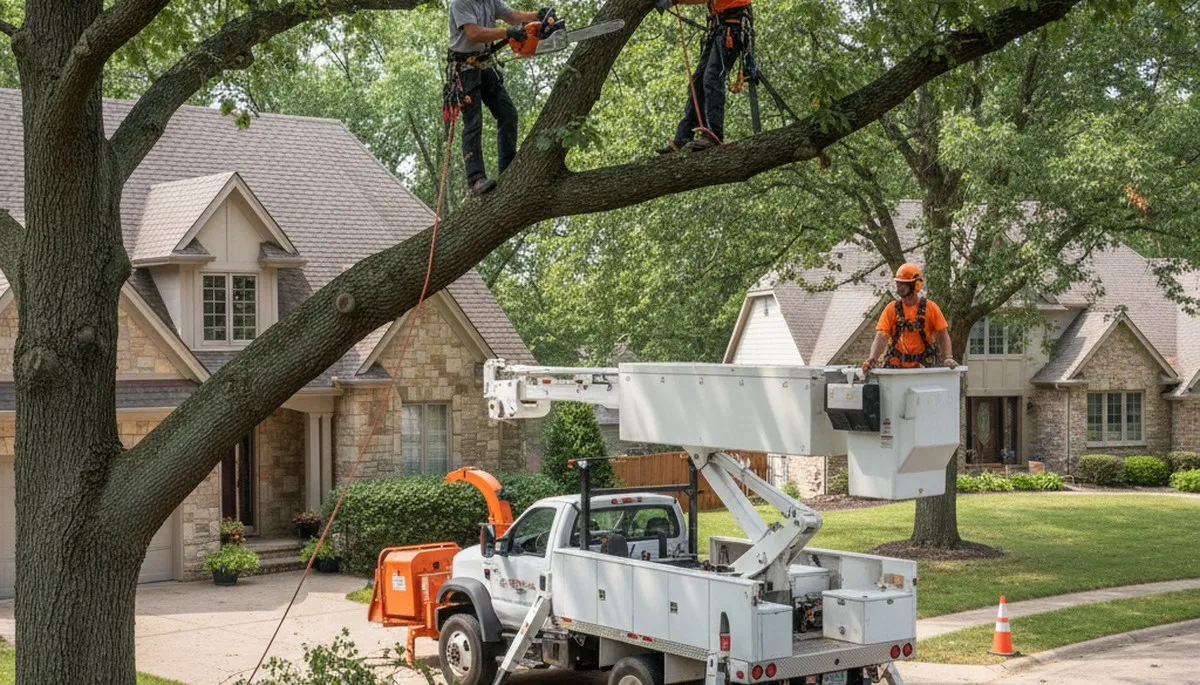
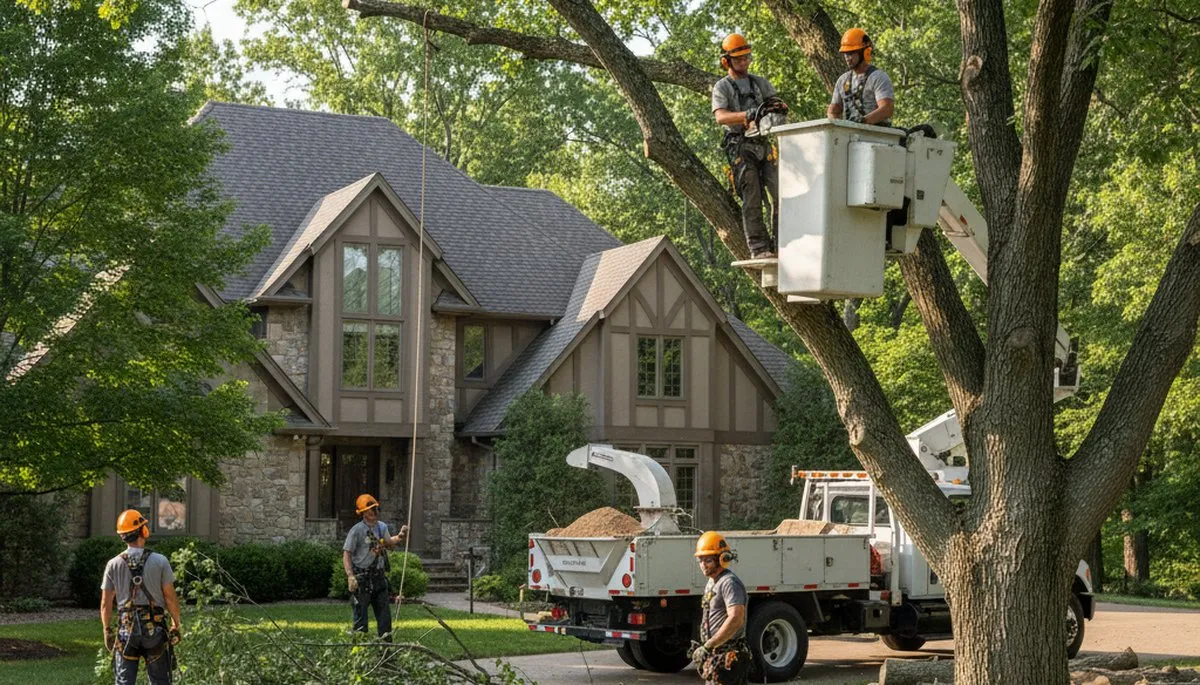
Experienced crews respond with aerial lift equipment, rigging systems, and organized debris removal to restore access and protect property after severe weather. Nearby, emergency tree services in Leawood, KS follow the same standards for properties just south of the Overland Park boundary.
Tight Access and Equipment Limitations
Narrow side yards, privacy fencing, and established landscaping are common in Overland Park’s older subdivisions, which makes large tree removal and stump grinding much more complicated than work on open rural land.
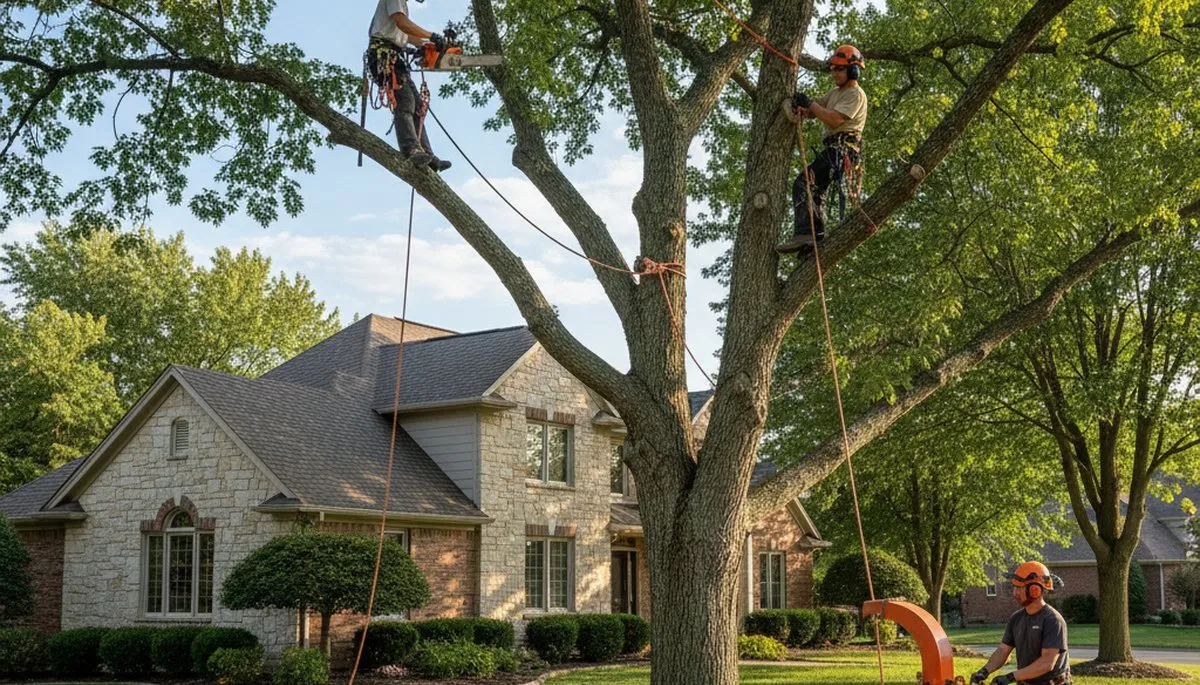
Local crews rely on compact track equipment, hand-rigging, and sectional removal methods to limit disruption to turf, fencing, and hardscape while still completing the job safely. For similar access challenges in nearby communities, tree trimming services in Lenexa, KS use the same site-aware approach.

Begin your tree service project today!

Tree Services in Overland Park, KS: Seasonal Care for Every Property
From regular maintenance to urgent storm cleanup, local crews help Overland Park properties stay neat, stable, and protected all year long:
Routine Tree Trimming and Pruning in Overland Park, KS
- Canopy clearance along utility corridors — Trimming branches near power lines around Metcalf Avenue and 135th Street helps reduce outage risk and keeps easements clear throughout the year.
- Crown thinning for mature oaks and maples — Opening up dense hardwood canopies in neighborhoods like Nottingham Forest improves airflow and can lessen fungal pressure during humid Kansas summers.
- Structural expert tree pruning services for co-dominant stems — Correcting weak unions and included bark on older trees helps lower the chance of major limb failure during the region’s frequent high winds.
- Seasonal shaping for ornamental and flowering trees — Dogwoods, redbuds, and ornamental pears in newer neighborhoods near 159th Street benefit from pruning timed to protect bloom cycles and guide healthy growth.
- HOA-compliant trimming for managed communities — Many neighborhoods, including Deer Creek and Wilshire Farms, have standards that require consistent, professionally maintained tree profiles.
Plan trimming before spring growth begins so the canopy stays manageable and mid-season corrections are less likely.
Tree Removal Services in Overland Park, KS
- Hazardous tree removal near structures — Leaning or weakened trees near homes along College Boulevard and 119th Street often need controlled sectional removal to protect roofs, fences, and utility lines.
- Dead tree removal before storm season — Standing dead elms and ash trees, especially those affected by emerald ash borer, can fail suddenly during thunderstorm season and should be removed early.
- Storm-damaged tree removal — Trees that split, uproot, or lose major limbs in severe weather need prompt professional tree removal solutions to reopen access and prevent further damage.
- Selective removal in dense canopy clusters — Overcrowded tree groupings in older neighborhoods may need targeted removal to reduce competition and improve the health of surrounding trees.
- Large-diameter hardwood removal — Mature bur oaks and silver maples with trunks over 30 inches across often require crane-assisted or rigging-based removal to manage weight and direction on tight lots.
Taking down hazardous or dead trees before winter ice arrives helps lower the chance of uncontrolled failure that can damage structures, fences, and nearby healthy trees.
Stump Grinding and Cleanup in Overland Park, KS
- Residential stump grinding after tree removal — Grinding stumps flush with the ground in manicured front yards removes trip hazards and makes lawn restoration easier.
- Below-grade grinding for replanting sites — If new trees will be planted, grinding 10 to 12 inches below grade helps clear root competition and prepares the soil for establishment.
- Multi-stump clearing in subdivision lots — Older neighborhoods near Quivira Road may contain several leftover stumps, and batch grinding keeps the work efficient.
- Stump removal near hardscape and driveways — Stumps beside concrete drives, retaining walls, or patio edges in Hallbrook and Indian Creek require careful grinding to avoid damage to nearby structures.
- Post-grinding debris and chip management — After grinding, chips are removed or spread as mulch around nearby beds, leaving the property neat and ready for reseeding or landscaping.
Prompt stump grinding helps prevent regrowth, reduces pest activity in decaying wood, and restores a clean, usable area on your Overland Park property.
Emergency Tree Services in Overland Park, KS
- Fallen tree removal after severe storms — When thunderstorms drop large trees across driveways, roofs, or roads in Overland Park, quick-response crews clear the debris and restore access as soon as it is safe.
- Hazardous limb extraction from structures — Storm-damaged limbs resting on roofs, in gutters, or against fences near 151st Street need careful removal to avoid making the damage worse.
- Uprooted tree stabilization and removal — Trees with shallow roots in clay-heavy soil are more likely to tip during saturated conditions after heavy rain, and emergency crews handle those situations with rigging and sectional cutting.
- Post-ice-storm canopy damage response — Ice storms can overload trees across entire neighborhoods, causing multiple limb failures; emergency storm damage response addresses both the immediate hazard and related structural concerns.
- 24-hour response for blocked access and utility hazards — If fallen trees or large limbs block driveways, sidewalks, or create danger near power lines, emergency crews focus on fast clearance to restore safety and access.
Because Overland Park has both dense canopy coverage and frequent storm exposure, it helps to have a local crew familiar with the area’s trees and access conditions before severe weather hits.